A word of warning to those who think a Labour landslide is now certain. The word, or more accurately number, is “2017”.
Never have the wheels flown off a party’s election bus more spectacularly than in the middle of the Theresa May’s election campaign. She was trying to defend her new policy for funding social care. It had been widely condemned as threatening a “death tax” on elderly home-owners. She tried to calm things down by saying “Nothing has changed. NOTHING HAS CHANGED.” The journalists questioning her were as unconvinced as the voters. Her campaign slogan was that she was “strong and stable”. Channel 4 News’s Michael Crick asked: “Doesn’t this show that you are really weak and wobbly”?
This episode should remind us to be wary of opinion polls a month before polling day. At the start of the 2017 election, the Conservatives enjoyed an 18 point lead over Labour. In the event the gap was just over two per cent, and the Tories needed a deal with Northern Ireland’s Democratic Unionists to reach a majority.
If the gap can narrow once by 16 points, it can happen again. Maybe Labour’s lead just now is more fragile than it looks. After all, polls have misled us before. They predicted wrongly that the Tories would fail to win a majority in 1970, 1992, and 2015 – and that they would keep it in February 1974. For that matter, the most polls went awry in 2017, for although they did show the Tory lead slipping after the social care debacle, the final polls put them on average still seven points ahead of Labour.
The chart below sets the record of polls in the last eight elections. It shows that 2017 was exceptional – but also that the final results of other elections have often been different from polls conducted a month earlier. As we look ahead to July 4, the data suggest that we should consider two factors. Will the campaign shift the numbers? And, are the polls accurate?
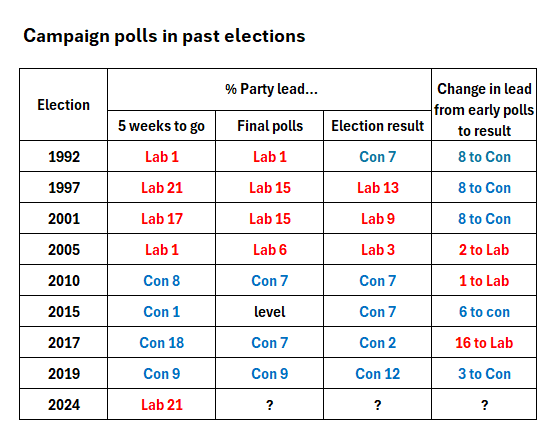
In Labour’s two landslide victories, 1997 and 2001, the party’s margin of victory was eight points narrower than its average polling lead a month earlier. Campaigning effect or polling error? A bit of both. The polls did show Tony Blair’s lead slipping, but most still overstated it in their final forecast.
1992 was in one way the same. The polls also showed an eight-point difference between the start of the campaign and the result. But on average the polls showed Labour narrowly ahead throughout. There was little or no campaign effect. But none of them came near predicting John Major’s victory by seven points. The eight-point shift was all polling error. The Conservatives were ahead throughout. Much the same happened in 2015.
In two of the eight elections, 2005 and 2009, neither the campaign nor the polls supplied any real shocks beyond the occasional rogue figures which, as usual, attracted far more attention than they deserved. It was the same in 2010, sort of. The first TV leaders’ debate led to Cleggmania and a surge in support for the Liberal Democrats. They lost about half that gain in the remaining three weeks. The Tory-Labour balance was unaffected. Thepolling gap ended close to where it started – and close to the result.
What are the lessons of all this for this year’s election?
For a start, polling averages are useful but not infallible. They are useful because they iron out sampling fluctuations to which all individual polls are prone. They provide the noise when what we need is the signal. By combining the data from all the companies that publish voting intention weekly, we can make like-with-like comparisons. In the past few days, Opinium has shown Labour’s lead up six points, while YouGov’s figure is down two. The ten-poll average tells us there has been no change. That’s the thing to concentrate on.
But if we can be sure about the stability of Labour’s lead, we can be less certain about its level. Within 24 hours last week, we had YouGov reporting a 27 point lead and JL Partners a 12 point lead. Part, but only part, of the reason is that they handle their data differently.
YouGov takes the “pure” approach. It adds up the number of people who say they back each part and publishes the percentages. JL Partners start with the raw data and adjust it in order to estimate what people would actually do in the election. In particular it explores the large number of people who voted Tory in 2019 and now say they don’t know. YouGov leaves them out of their published figures; JL Partners make a judgement about their likelihood of actually voting and, if so, who for. (Their latest poll has Labour’s lead back up to 17 per cent. Last week’s 12 per cent might have been an outlier.)
The effect – and it is similar for Opinium, the other company that makes these adjustments – is to reduce Labour’s lead by around six points. YouGov’s latest MRP also adopts a modelling approach. Although it has made headlines with its projection of a 194-seat Labour majority, it reports a Labour lead of 18 per cent which is actually well below its recent “pure” leads of 25-27 per cent.
All in all, “pure” polls put Labour’s lead around the mid 20s in percentage terms, while “modelling” polls put the lead in the mid-to-high teens.
This modelling approach has had its successes. Following the polling debacle in 1992, ICM’s Nick Sparrow changed his methods. In 1997 he consistently reported Labour leads lower than those of other companies. ICM’s final poll said Labour would win 43 per cent. Its four rivals predicted 47-50 per cent. Labour won 44 per cent.
It’s possible that as election day draws near, “don’t knows” will climb off the fence, and the “pure” and “modelling” projections will converge. But if they don’t, I would expect the modelling approach to be nearer the result. If that is right, then Labour’s current, adjusted, lead is around 16-18 points. With the exception of 2017, no post-1945 election has seen movements that would wipe out that lead – however badly the polls performed.
Two conclusions can be drawn from this. The first is that, short of something spectacular happening, Labour will win the election comfortably, even if the pollsters end up having one of their occasional rotten elections (as I did at YouGov in 2015.)
The second is that if “something spectacular” does take place, it is likely to be an event that wrecks a party’s reputation. It must be something that causes the relationship to be break down between its leader and its voters.
I’d prefer to say that new, popular policies delivered with panache will lift a party’s vote dramatically. In practice, during the final weeks of a campaign, positives mainly reinforce existing support rather than win big numbers of new converts. It was May becoming “weak and wobbly” that transformed the 2017 election. By far Starmer’s most important task over the next four weeks is to avoid the disaster of a “weak and wobbly” moment of his own.
This blog was first published by Prospect

 Peter Kellner. The Politics Counter